

 | ||||||
 HAVE YOU EVER HEARD OF THE LIGHTS OUT CLUB?No? Well, for the first 140 years of its existence, the rest of society wasn't supposed to know about it. It all began back in 1796, when Alexander Hamilton, one of America's founding fathers, had just given the new nation its first sex scandal which had left him temporarily unemployed. He retreated to Manhattan, his home town, to lick his wounds. Bored out of his mind, he was able to convince six prominent New Yorkers to entertain themselves each week by sharing tales of terror by the light of a solitary candle. For an extra jolt, they would meet in dark, out-of-the-way, often, dangerous places. Their spooky tales were based upon personal experiences, or, true events which had taken place in NYC. As the group grew, the secret membership was by reference only and restricted to New Yorkers. They called it THE LIGHTS OUT CLUB.To this day, this legendary, influential group has continued on, attracting members from all walks of life, from school teachers to politicians, cops, athletes, vaudevillians, gangsters, authors and Hollywood superstars ...everyone, it seems, has a terrifying story to tell...and loves hearing them, as well. Past members include MARK TWAIN, EDGAR ALLAN POE, ORSON WELLES, LEGS DIAMOND, RODNEY DANGERFIELD, ENRICO CARUSO, NORMAN MAILER, SOPHIE TUCKER, ROD SERLING and dozens more!NOW, for the first time ever, THE LIGHTS OUT CLUB has authorized long-time member, DAN BIANCHI, to collect, catalog, record and transcribe its tales to the written page, and, to edit and conserve hundreds of weird stories of New York's ghosts, creatures, haunted houses and strange incidents, all of which have taken place in real NYC locations...and, often concern historical figures and events. Here are eerie tales of old Manhattan which have not seen the light of day since the first night they were told by the light of a solitary candle!
 The following Lights Out story was based upon the medical files of a Dr. Samuel Morley in the year 1840. In this case, however, Dr. Morley was not the doctor, but, a patient incarcerated behind iron bars within the Bloomingdale Asylum For The Insane in upper Manhattan. A year later, since his estate could no longer afford to pay this hospital which catered to privileged families, he was removed to the asylum on Blackwell’s Island in the East River.It’s a fact that most of the hospital’s records before 1900 were lost in a fire, but, for some reason, a bundle containing files from the year, 1840, regarding the patient, Dr. Morley, were found in the attic of a house on Long Island in 1952. The house was once occupied in the late 19th Century by a Dr. J. Edwin Greeley. It is not known if Morley had been Greeley’s patient. The records, now within the collection of the New York Academy of Medicine, contain many interviews with Morley as he slipped deeper into psychosis. He died in his cell in 1846 at the age of 46. He was destitute and had no living family members, so, by mistake, he was buried in an unmarked pauper’s grave on Hart’s Island rather than in the Morley’s mausoleum.This horrifying case is said to have inspired Club member Edgar Allan Poe to write his 1835 short story, “Morella.” To date, no biographer has been able to explain how the young Poe had known about this macabre tale. Is it possible that he had first heard about it at The Lights Out Club?Club lore has it that Poe was quite a tale-spinner, not just on the written page, but, live and before audiences. At least, one account claims, that, “he had just the right voice for creating chills in his listeners.” Imagine! To be sitting in the dark while candlelight flickers upon the grim visage of Poe, the father of American Horror, as he tries his best to scare the hell out of The Lights Out Club with his latest terror tale? Did he present “The Raven?” “The Tell-Tale Heart?” “The Cask of Amontillado?”I’ve not found any evidence of that, but, I’d like to guess he had performed them before the Club during the short time he had lived in Manhattan. It would not be the first time Poe was inspired by a true mystery. Both “The Mystery of Marie Roget” and “Murders In The Rue Morgue” were based on actual murder cases. As for the following story, had it not been based on real people and a documented case study, it is so bizarre, that, one might think, Poe was not only inspired by it, but, he had wholly created it.How is it that a brilliant, young medical doctor named Samuel Morley came to spend his final days locked inside a padded room within the most notorious insane asylum in New York? His journey to this ignominious end began one night, some years earlier…It is 10:30 P.M., April 11, 1825… Morley has just attended a black-face melodrama at the Bowery Theater, which has, after the past ten years, sunk to a new low. Once a reputable center for English drama and Italian opera, its management must now cater to an audience filled with shouting hooligans and prostitutes. As he exits the theater, jostled between the noisy throng pouring out on to Park Row, the young Dr. Morley vows never to return.Dr. Morley, a bachelor, is bored and lonely. He is about to hail a carriage, when he looks up and…there she is…dressed in black, as if, in mourning. Her melancholy eyes, even from behind their veil, stare deeply into his. Oddly, he detects some…invisible force…between their beings, pulling them together. A spiritual connection. Instantly, he knows that their souls will become bound as one, forever.
Chapter 4
DR.MORLEY’S BRIDE (Bond Street, 1820-30s)
Long ago, when people were found to be involved with the strange and uncanny, the supernatural and ghostly, they were promptly burned at the stake. As our society became more enlightened about such things during the mid-1800s, such people were quietly shipped off to madhouses, terrible places not much better than medieval dungeons. By 1850, nearly eight out of ten families, rich and poor, had, at least, one relative in a madhouse. It’s no wonder that many Lights Out Club members turned to tales of madness which they may had witnessed first-hand.
Dr. Samuel Morley (1800-46)
| ||||||

Blackwell's Island Lunatic Asylum, NYC 1800s

Edgar Allan Poe
(1809-49)
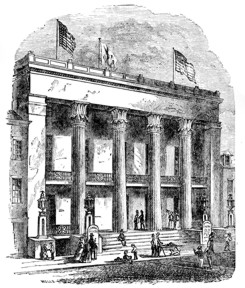
BOWERY THEATER, 1825
But, he is not the type to boldly introduce himself to strange females. He need not worry about that. This enigmatic woman, Artemia De La Brioschi…it is she who invites him to her home. It is she who reels in the little fish. Though she speaks fluent English, he detects a foreign accent he cannot determine. He learns that she comes from European royalty, a duchy somewhere in the Balkans. But, now, she is alone in this bustling city. Artemia appears to be his age, but, she speaks and carries herself as if she is much older. Yes, an old soul lies within her beautiful frame.Also, she is, without doubt, wealthy…much wealthier than a mere New York physician who boards in a two-story house on Factory Street. Of course, he does not inquire how she supports herself while living in a Greek Revival mansion situated on fashionable Bond Street. Compared to Morley, her neighbors are upper class. Why, living right next door to her is the esteemed Albert Gallatin, once Secretary of the Treasury under Presidents Jefferson and Madison, and, he is the founder of New York University. Since Artemia lives alone on Bond Street and has no visible means of support, Dr. Morley must assume that she is the inheritor of old world wealth.
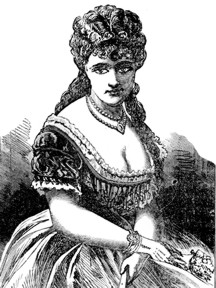
ARTEMIA DE LA BRIOSCHI
Regardless of their social differences, in no time, the man and woman become involved with each other, intimately. However, they are not lovers. Not really. Yes, he is infatuated with her, surely…she is so beautiful, alluring, mysterious…but, for love to exist, there must be a mutual infatuation, no? Morley is not a fool. He’s already begun to believe that she can never truly return this feeling for him. Why? Perhaps, she is incapable of true love? He has heard of such personalities. Then, why has she chosen him?As with most love-besotted victims, Dr. Morley misleads himself into believing that he can cure her of this lack of desire. They become engaged, and, after just two months, they are married. From the moment she swears herself to him, she shuns the rest of the world. They go nowhere, together, even though they are invited to grand balls and stylish homes of the richest and most influential families in New York City. She claims that she has no concern for such trivial pursuits. At first, she goads him into attending these social functions, but, alone. Shortly, thereafter, Dr. Morley finds himself turning down invitations…even from his own wealthy patients, city officials and board members of Bellevue Hospital. Can he defend his wife’s bizarre behavior? Though it harms his own reputation, he does just that. At this point, Morley still considers himself to be a lucky man to have married this exceptional beauty.Two years pass. During that time, Dr. Morley discovers that his wife is exceptional in other ways. She is very knowledgeable in a wide variety of subjects. So much so, that, at times, he feels as if he is her pupil. She speaks many languages. And, smart? She can easily attend Harvard or Yale, if women were allowed to do so. But, aside from the basic academics…she also devotes a great deal of her time to studying what is called… Forbidden Lore. These are mystical writings which no university would dare teach. Artemia invites her husband to join her as they enter into another world beyond their own. Of course, he believes himself to be a modern man of science, but, he cannot resist her. So, he delves into the unspeakable works laid before him. It’s, as if, he has no opinion of his own. He falls completely under his wife’s guidance. She dominates his mind, as well as, his heart and soul.
And, body…though it might not be considered love- making, yes, they do revel in the pleasures of the flesh. Long into the night, the household servants can hear their vociferous sexual encounters.The man becomes a human puppet and Artemia the puppeteer. She just has to place her cold hand upon his own and rake up the ashes of a dead philosophy and some incantation as its strange meaning burns itself upon his memory. For hours, he listens to her voice tainted with terror…an unearthly sound… and there falls a shadow upon his soul that makes him turn pale. It’s not long before he fails to keep his appointments with patients. The hospital board has warned him once, twice…the next time he neglects his work, he shall be stricken from their roster. The man is now obsessed beyond caring. For the addicted, what was once joy begins to blend into horror. The most beautiful becomes the most hideous.Meanwhile, Artemia is no less obsessive. She talks, incessantly, about her beliefs, about personal identity…perhaps, it is not lost forever at the time of death? Perhaps, it can go on…and on? What does she mean by that? Now, life turns unbearable for Morley. Is he under her spell? In one of his medical files, this note was found, presumably written by Morley…“A curse! That’s it. That’s how one may describe it. I can no longer bear the touch of her thin fingers…nor the low tone of her voice…nor the dull glow of those melancholy eyes. I know, I know. Why don’t I say something to her? Why not let her know how I feel about all this? I do. I do ask, but, she won’t discuss it. I suppose she considers me a weak man. Sometimes, I feel as If I was chosen by her for some grand experiment…just a test subject. But, for what? Other times, she’ll just shake her head and say…it all has to do with Fate. As if she knows that some great unknown power beyond herself has caused this to happen.”Months drag on. He begins to notice the blue veins in her pale forehead becoming prominent…and her cheeks are withdrawn and her eyes are glazed. And, she tells him that she is with child. He cannot believe his ears. Artemia carries their child. Why? Certainly, it is not a child born of love. Can it be, that, this child, too, is only part of some unearthly experiment? The very thought causes Morley to burn with resentment.But, it’s also apparent that the poor woman has little time to live. In an instant, his anger and fear melt into pity. He rebukes himself for his stupidity. How could he have been so damned afraid of her? Stupid, silly man. He must express his abject apologies, but, no sooner does he turn his gaze to her eyes… staring at him…the expression on her face makes his blood run cold. Does he want her dead? Yes, Morley tells his interviewer that he had wished his wife dead, but, then, he quickly amends that with…“It is not because I was afraid of her, but, I did not want her to suffer. She didn’t deserve to die that way.”Artemia lingers on. Her fragile spirit clings to life for days, weeks, into months. The records and interviews show Morley, at the time of Artemia’s illness, to have been mentally tortured, out of control, on the verge of a nervous breakdown. As time passes, he grows furious. He curses the days, the hours, which seem tolengthen as her gentle life declines…like shadows in the dying of the day.
One autumn evening, Artemia calls him to her bedside. She’s muttering wildly one moment and, the next, she’s barely awake. She’s had more than enough laudanum. No matter if he blames her for the fear and animosity between them…he does not want her to die like this. It’s not right. She babbles, on and on, but, he pleads for her to save her breath. He kisses her, madly. She sounds as if she is apologizing for her life, for their life, together. He is not sure what she means, but, he forgives her, profusely. She promises him that she will be with him, always …even in death…which is approaching quickly.“I did not want to hear such a pledge. But, my dear wife…she was telling me that she knew how much I loved her, how devoted I was to her. She predicted, that, at the moment her spirit should leave her mortal frame…the child will live. Our child.”Although the cholera epidemic had just killed thousands in New York City, it is most likely that a difficult pregnancy is causing his wife to suffer. However, whether the laudanum is talking, or, some inherent evil within her, she stops praising her husband during her final moments and turns to harassing him. She accuses him of hating her since they first met…and hating everything she believes in. He pleads his case that her accusations are untrue, but, at this point, it does not matter.“Her final words to me were a curse…a curse upon me…why? What had I done? Was she so envious that I was to go on living without her? Had I represented life and she symbolized its enemy…death? I don’t know, I don’t know. She said that my remaining days would be days of sorrow. She prophesized that I would no longer know happiness. Why? Why?”The midwives enter and do their business and, at the very moment the baby takes its first breath, Artemia draws her last. As she had predicted, in dying she has given birth.Months whirl by into years. The child grows strangely in stature and intellect, and, is the perfect resemblance of her dead mother. Morley loves her with a love more fervent than he has ever believed possible to feel for any human being. But, will it last? Not likely. Fear and trepidation still surround him. Indeed, the child has grown abnormally fast in both physique and acumen. He is astounded to find that, even now, the child has the powers and faculties of an adult woman. The words that come from her mouth…the wisdom? From a child? It doesn’t take long for him to realize that something dark and terrible is at work here. And, always, his thoughts return to the entombed Artemia.But, how believable is this story told by a patient locked in a padded cell? The daughter’s body size had increased rapidly? She spoke like an adult? Were these the rants from a diseased mind? There is no evidence to support his claims, but, evidently, Dr. Morley truly believed that the child was possessed by his dead wife’s spirit.“And, this is the way I’ve lived, terrified, year after year…day after day, gazing upon my daughter’s holy and mild, and eloquent face…while witnessing her body turn mature as she resembles her mother, more and more. Her features grow more definite, more perplexing, more hideous. Her smile is like her mother's. I can bear that. Her eyes are like Artemia's. I can endure that. But, when they look down into the depths of my soul with Artemia's own intense and bewildering meaning…? Then, there is the contour of the high forehead, her silken hair, the thin fingers…the deep sound of her voice and, above all, oh, above all, when the child speaks the same phrases and expressions …how can she know these words? Said in the same tone of voice as…? Well, it consumes me with horror. It’s like a worm in my brain that will not die.”By the time of her fourth birthday, the child appears to be twice, three times, her age. He has never even named his daughter. He calls her simply, My Child. No, he would never give her his wife’s name. Artemia’s name died with her at her death. He has never spoken about her to his daughter. He forbids her to question him about her mother. During the brief period of her existence, his daughter has seen little of the outside world. What will she look like when she is ten…twelve? What can he do to stop this calamity from progressing further?“And, then, it came to me! Perhaps, if the child were baptized, the both of us may be spared the horror of destiny. How dare Artemia terrorize me, convincing me that I am helpless against Fate! Well, I’ve made up my mind! My daughter shall be baptized.”But, he needs a name for her. He can think of many, of course…gentle, good, happy names. He makes his choice. But, what happens? When he stands at the baptismal font with the child next to him…and the priest before him, prompting him for a name…he cannot say the name he has chosen. No! There is something gnawing at his thoughts. Some demon urging him to breathe that sound, that name, which, in its very recollection will make his blood run cold! A fiend now speaks from the recesses of his soul. And so, here, standing in the dim aisle, in the silence of the night…when the priest asks for a name, Morley answers with a whisper…“Artemia!”According to Morley…“Suddenly, there was thunder! A loud crash! A window exploded. I heard a scream bellow from the depths of Hell. And, a wind nearly knocked me down, while the priest fell to his knees
and shouted, ‘What devil’s work is this?’ My Child convulsed…her skin was turning white! Her
eyes to glass! She fell back upon the marble slab and…from her lips, I heard a reply…’It is I!’
The words echoed through the hollow church. Like molten lead, they hissed deeply into my
brain. I shall never forget that moment for as long as I live. ‘Artemia! Artemia!’ the voice
repeated until the winds breathed but one more sound within my ears … ‘Artemia!’”
There is no official death certificate for the child, but, Morley, a doctor, maintains she died on December 12th, 1833.“With my own hands, I carried her to the funeral carriage and brought her to my family’s mausoleum in Calvary Cemetery where I had entombed my wife some years before.”It’s a long ride, over the East River by ferry and, then, a carriage out to the graveyard in the countryside. By nightfall, he arrives and enters the tomb. The great iron door creaks open. To the left and right of him are stone caskets of several ancestors.But, situated in the middle of the floor is the marble casket wherein lies the corpse of Artemia. He shall lay their daughter next to her mother for eternity. With all his might, he shifts the great marble slab away to make room for his dead child …but, it is at this exact moment when he loses his mind to madness.The coffin is empty! His maniacal laughter reverberates throughout the cemetery.Later, when the authorities come to usher the poor man directly to the asylum, a gravedigger, who had found Morley laughing over his dead daughter, claims...“I’d been working on a grave not far from the tomb when I heard both a man and a woman’s roaring laughter which filled the air around me. The woman screamed a word several times …but, I could not make it out. Sounded like a name.”The authorities determine that the digger had been drinking and, so, quickly dismiss his story. When he tries to assure them that he is stone cold sober…they threaten to take him along to the insane asylum. He immediately retracts his story and curses the demon liquor for causing him so much trouble in life.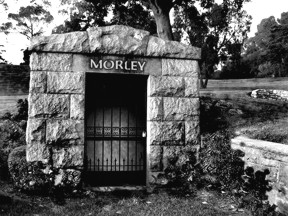
THE MORLEY TOMB,
CALVARY CEMETERY,
QUEENS, NY

ON SALE NOW!
$20 389 pg. Illustrated
House Of Fear Publishing, NY

EACH MONTH A DIFFERENT CHAPTER CAN BE READ BELOW
